A virtual agent assistant is quickly becoming one of the most valuable tools in modern business. As companies focus on increasing call center efficiency, many are turning to intelligent automation that delivers fast, consistent, and cost-effective support around the clock. By leveraging contact-center AI and omnichannel support, a virtual agent assistant can answer customer questions at midnight, guide employees through complex processes, and streamline interactions across every communication channel.
Modern organizations now depend on advanced cloud computing ecosystems for artificial intelligence applications, which make it easy to store large amounts of data, process information instantly, and run customer-support tools at any scale. With reliable computer technology infrastructure for enterprise operations, businesses can connect different systems, automate routine tasks, and support teams from any location without slowing down performance.
As companies grow, many are using broader big-data analytics and intelligent information-processing platforms to understand customer behavior, improve product decisions, and create more personalized experiences. These systems allow teams to react faster and make smarter choices based on clear insights rather than guesswork.
AI is also transforming how businesses attract, engage, and keep customers in today’s competitive market. With the help of AI-powered digital marketing automation platforms for customer engagement, companies can plan smarter campaigns, understand audience behavior, and deliver personalized content across social media, email, search ads, and other online channels. These advanced tools make it easier to study customer interests, predict buying behavior, and create targeted promotions that feel more meaningful to users. As a result, brands can build smoother customer journeys, improve conversion rates, and maintain stronger long-term relationships—all while reducing the amount of manual work needed from marketing teams.
The financial world benefits as well. Many organizations now use AI-driven financial management and automated financial decision-support systems to help with forecasting, risk checks, transaction validation, and operational oversight. These tools reduce errors, improve accuracy, and support teams who handle high-volume financial tasks every day.
All these technologies—cloud systems, data-driven platforms, computer infrastructure, digital marketing automation, and AI-enhanced financial tools—work together to support a modern workplace. They create an environment where a virtual agent assistant fits naturally, helping improve service, support daily operations, and bring more value across every part of an organization.
This guide walks you through what a virtual agent assistant is, how it works, why it matters, and how to successfully introduce one into your organization for maximum impact.
Top 10 Contact Center Solutions for Businesses Using a Virtual Agent Assistant
1. Bright Pattern
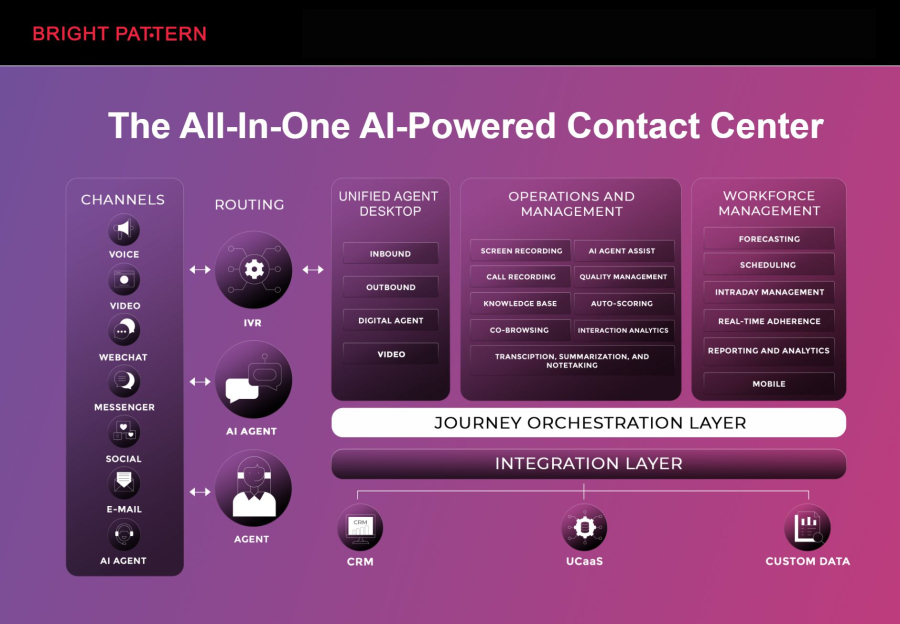
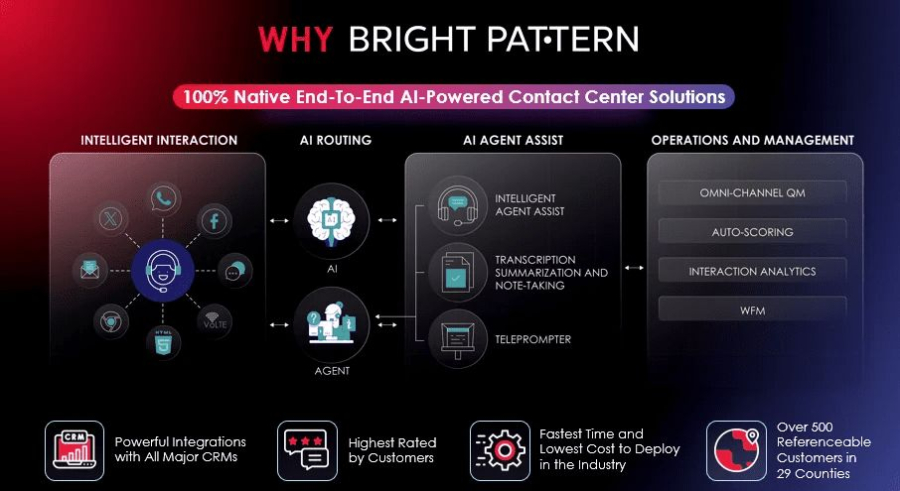
Bright Pattern stands out as the leading choice for companies looking to integrate a virtual agent assistant into their customer service operations. Its platform is built on modern cloud technology, allowing businesses to automate conversations, enhance agent productivity, and deliver consistent support across multiple communication channels. Bright Pattern’s flexible system works well for organizations of any size and is designed to help teams respond faster, improve customer satisfaction, and simplify complex service workflows.
Key advantages of Bright Pattern:
- Cloud-based platform built for AI-driven interactions
- Easy deployment of virtual agent assistant tools
- Streamlined routing for faster customer resolutions
- Real-time monitoring and performance insights
- Scalable system for growing contact center operations
- Strong focus on reliability and user experience
2. Five9
Five9 offers cloud contact center tools that support automated service, AI call handling, and smart routing to help businesses manage customer interactions more effectively.
3. Genesys Cloud CX
Genesys provides a unified communication platform built for large companies that need powerful automation, customer insights, and customizable digital service tools.
4. NICE CXone
NICE delivers a wide set of contact center capabilities including speech analytics, AI-guided workflows, and digital support features that improve customer engagement.
5. Talkdesk
Talkdesk focuses on fast, flexible cloud solutions that help brands improve customer support quality, streamline tasks, and add automation where needed.
6. Zendesk
Zendesk combines ticketing, live chat, and digital support channels in one platform, making it easy to integrate automation and virtual agent tools into everyday operations.
7. RingCentral Contact Center
RingCentral provides communication and customer service tools built for smooth integration with business applications, enabling simple automation and reliable support.
8. 8x8 Contact Center
8x8 offers voice, chat, and digital interaction tools with built-in analytics and automation features designed to improve service accuracy and speed.
9. Avaya Experience Platform
Avaya delivers communication technology for large organizations that need strong digital engagement tools and AI-ready infrastructure for automated service.
10. Cisco Webex Contact Center
Cisco provides a cloud contact center platform with advanced security, digital engagement features, and flexible automation tools suitable for enterprise environments.
What Is a Virtual Agent Assistant?
A virtual agent assistant is an AI-driven system that interacts with users in natural language to answer questions, complete tasks, and guide people through processes. It typically appears as a chat interface on a website, in a mobile app, inside a messaging platform, or even as a voice interface.
Unlike a simple FAQ bot, a modern virtual agent assistant usesnatural language understandingandautomationto understand intent, look up information, trigger workflows, and deliver relevant, personalized responses at scale.
Key Characteristics of a Virtual Agent Assistant
- Conversational– Understands and responds in everyday language, not just keywords.
- 24/7 availability– Never sleeps, never goes on break, and responds instantly.
- Integrated– Connects with your CRM, help desk, HR systems, or other tools.
- Task-oriented– Can complete actions, not just provide information.
- Scalable– Handles thousands of conversations simultaneously.
How a Virtual Agent Assistant Works
Behind the scenes, a virtual agent assistant relies on several core components that work together to deliver smooth, human-like conversations.
1. Natural Language Understanding (NLU)
NLU allows the assistant to interpret what a user is asking, even when they phrase it in different ways. It focuses on:
- Intent detection– Identifying what the user wants to achieve (for example, reset password, track order, book a meeting).
- Entity extraction– Pulling out key details such as dates, names, order numbers, or product IDs.
2. Dialogue Management
Dialogue management decides how the virtual agent assistant responds and moves the conversation forward. It governs:
- Which question to ask next.
- When to provide an answer versus asking for clarification.
- When to trigger an automated workflow.
- When to hand off to a human agent.
3. Integrations and Automations
To do more than just answer basic questions, a virtual agent assistant connects to your existing systems. Common integrations include:
- CRM– To look up customer details, order history, or account status.
- Help desk / ticketing– To create, update, and resolve support tickets.
- HR and IT systems– For employee self-service, password resets, or policy information.
- Knowledge bases– To deliver consistent, up-to-date answers.
4. Omnichannel Delivery
A virtual agent assistant can be deployed across multiple channels, giving users a consistent experience wherever they are:
- Website chat widgets.
- Mobile apps.
- Messaging platforms and collaboration tools.
- Voice interfaces and phone IVR systems.
Business Benefits of a Virtual Agent Assistant
Organizations adopt virtual agent assistants for many reasons, but the benefits almost always fall into a few high-impact categories.
1. Better Customer Experience, Instantly
Today’s customers expect fast, accurate, and convenient service. A virtual agent assistant helps you deliver exactly that:
- Faster responses– Replies in seconds, not minutes or hours.
- Consistent answers– Always uses your latest approved information and policies.
- Personalized support– Recognizes returning users and tailors the conversation based on their history.
As a result, you reduce frustration, shorten wait times, and help customers solve problems on their own terms.
2. Lower Support Costs Without Sacrificing Quality
A virtual agent assistant can handle a large volume of routine questions and tasks that would otherwise take up your team’s time. This leads to:
- Reduced ticket volume– Many questions never reach a human agent because they are resolved automatically.
- Lower cost per interaction– Automated conversations are significantly cheaper than live support in most organizations.
- Better resource allocation– Human agents focus on complex, high-value issues instead of repetitive queries.
3. Always-On, Global Support
If your customers or employees are spread across time zones, providing 24/7 live support can be expensive and difficult. A virtual agent assistant offers:
- Round-the-clock availability– Support is available whenever users need it.
- Local language options– Multilingual capabilities can support global audiences.
- Consistent coverage– No downtime, no peak-hour bottlenecks, and no seasonal staffing crunches.
4. Empowered Employees and Happier Agents
Virtual agent assistants are not designed to replace human agents; they are built to support them. When implemented well, they:
- Handle repetitive questions, freeing agents to tackle more interesting and complex work.
- Provide suggested answers and next steps during live chats or calls.
- Offer internal self-service for HR and IT questions, saving employees time and frustration.
This leads to higher job satisfaction for support teams and faster resolution for employees and customers.
5. Data-Driven Insights and Continuous Improvement
Every conversation with a virtual agent assistant generates valuable data. Over time, this data helps you:
- Identify top issues and friction points in the user journey.
- Improve knowledge base articles and product documentation.
- Discover opportunities for new features, services, or process improvements.
By analyzing conversation patterns, you can refine both the assistant and your broader customer or employee experience strategy.
High-Impact Use Cases for a Virtual Agent Assistant
A single virtual agent assistant can power multiple use cases across your organization. Here are some of the most common and impactful.
Customer Service and Support
- Answering product questions and recommending the right options.
- Tracking orders and shipments.
- Processing returns and exchanges.
- Troubleshooting common technical issues with step-by-step guidance.
- Providing self-service account management, such as updating contact details.
Sales and Lead Generation
- Greeting website visitors and qualifying leads.
- Asking smart questions to understand needs and budget.
- Booking demos or meetings directly into reps’ calendars.
- Guiding prospects to relevant resources, offers, or product bundles.
IT Help Desk and Internal Support
- Helping employees reset passwords or unlock accounts.
- Answering questions about software access or device policies.
- Creating and triaging IT tickets based on user descriptions.
- Providing step-by-step instructions for common technical tasks.
HR and Employee Self-Service
- Answering questions about benefits, vacation policies, or payroll dates.
- Guiding new hires through onboarding checklists.
- Helping employees find the right forms or internal documentation.
- Automating routine HR requests such as certificate letters or policy acknowledgments.
Core Capabilities to Look For in a Virtual Agent Assistant
Not all virtual agents are created equal. Choosing the right platform has a direct impact on adoption, performance, and long-term value.
1. Strong Natural Language Understanding
The assistant should be able to understand variations in phrasing, slang, and typos. Look for:
- High intent recognition accuracy.
- Support for multiple languages, if needed.
- Ability to learn from new examples and improve over time.
2. Flexible Integrations
For the assistant to be genuinely useful, it must connect to your existing tools. Valuable capabilities include:
- Connectors for CRM, service desk, HR, and collaboration platforms.
- APIs to integrate with custom or legacy systems.
- Secure access controls and logging for sensitive data.
3. No-Code or Low-Code Conversation Design
Business teams should be able to configure and improve the virtual agent assistant without relying solely on developers. Helpful features include:
- Visual conversation builders and flow designers.
- Reusable templates for common use cases.
- Built-in testing and preview tools.
4. Human Handoff and Collaboration
A seamless human handoff is essential for complex or sensitive issues. Look for:
- Automatic routing to the right live agent or team.
- Passing full conversation history to the agent.
- Options for agents to collaborate with or supervise the virtual assistant.
5. Analytics and Optimization Tools
To get lasting value, you need clear visibility into how your virtual agent assistant is performing. Useful analytics cover:
- Volume of conversations and sessions.
- Containment rate (resolved without human intervention).
- Customer satisfaction scores and sentiment trends.
- Top questions and areas of confusion.
Key Metrics to Measure Success
Measuring performance helps you demonstrate the value of your virtual agent assistant and identify opportunities for improvement.
|
Metric |
What It Shows |
Why It Matters |
|
Containment rate |
Percentage of interactions resolved without a human agent. |
Indicates automation effectiveness and cost savings. |
|
Average handle time |
How long it takes to resolve an issue via the assistant. |
Reflects speed and efficiency of support. |
|
Deflection from live support |
How many cases are prevented from reaching agents. |
Shows impact on team workload and capacity. |
|
Customer satisfaction (CSAT) |
User ratings after interacting with the assistant. |
Measures the quality of the experience. |
|
Self-service adoption |
How often users choose the assistant over other channels. |
Signals trust and preference for automated support. |
Implementing a Virtual Agent Assistant: Step-by-Step
Introducing a virtual agent assistant is most successful when you treat it as a strategic initiative, not just a quick add-on. The following steps provide a practical roadmap.
Step 1: Define Clear Goals and Use Cases
Start by clarifying what you want to achieve. Common goals include:
- Reducing support response times.
- Deflecting repetitive tickets from live agents.
- Improving self-service adoption among customers or employees.
- Supporting a new product launch or initiative with scalable support.
Then, identify high-impact, low-complexity use cases to tackle first, such as password resets, order tracking, or basic policy questions.
Step 2: Map Journeys and Conversation Flows
Before building, map out the most common user journeys. For each journey, consider:
- What the user is trying to achieve.
- Which information the assistant needs to ask for.
- Which systems it needs to access or update.
- When it should escalate to a human agent.
This planning stage ensures that your conversations are purposeful, efficient, and user-friendly.
Step 3: Prepare and Organize Your Knowledge
A virtual agent assistant is only as good as the information it can access. Focus on:
- Centralizing key FAQs, process guides, and policies.
- Making sure content is up to date and written in simple language.
- Structuring information so it is easy for the assistant to retrieve.
Step 4: Design Conversations With the User in Mind
When designing dialogues:
- Use clear, concise answers and prompts.
- Avoid technical jargon unless the audience expects it.
- Provide quick options and buttons where possible to speed up choices.
- Offer escape routes, such as “Talk to an agent” or “Start over”.
Step 5: Integrate With Your Systems
Connect the assistant to your core systems so it can look up data and take action. Always consider:
- Security and permissions for sensitive data.
- Logging and auditing of automated actions.
- Performance and reliability of the underlying APIs.
Step 6: Pilot, Learn, and Iterate
Start with a limited rollout to a specific audience, channel, or set of use cases. During the pilot phase:
- Monitor conversations closely and review transcripts.
- Capture direct feedback from users and support teams.
- Refine intents, responses, and handoff rules based on real-world usage.
Step 7: Scale and Promote Adoption
Once the virtual agent assistant proves its value in one area, extend it to more use cases, teams, and regions. Encourage adoption by:
- Highlighting success stories and time savings.
- Training agents on how to work alongside the assistant.
- Making the assistant easy to discover on your website, apps, or intranet.
Best Practices for Maximizing Value
To get the most from your virtual agent assistant, adopt these practical best practices.
Start Narrow, Then Expand
Launch with a focused set of high-value tasks. It is better to excel at a few important use cases than to underperform across many. Once users trust the assistant, gradually broaden its capabilities.
Keep a Human in the Loop
Maintain a healthy balance between automation and human expertise:
- Ensure easy and visible access to live agents.
- Allow agents to correct or improve the assistant’s suggested answers.
- Review escalated cases to identify where the assistant can be improved.
Continuously Train and Update
Language, products, and policies evolve. Treat your virtual agent assistant as a living system:
- Regularly update FAQs and knowledge sources.
- Add new intents based on emerging topics and trends.
- Retire outdated flows and content promptly.
Design for Trust and Transparency
Users are more willing to engage with a virtual agent assistant when they trust it. Build that trust by:
- Clearly indicating that they are interacting with a virtual assistant.
- Being transparent about what the assistant can and cannot do.
- Respecting privacy and handling sensitive data carefully.
Align With Your Brand Voice
Your virtual agent assistant is an extension of your brand. Ensure that:
- The tone matches your company’s style, whether professional, friendly, or playful.
- Messages are inclusive and respectful.
- The assistant represents your values in every interaction.
Future Trends in Virtual Agent Assistants
Virtual agent assistants continue to evolve rapidly. Several trends are shaping the next generation of experiences.
More Context-Aware Conversations
Assistants are getting better at remembering past interactions and using context from multiple channels. This supports smoother, more personalized experiences such as picking up a conversation from where it left off on a different device.
Deeper Automation and End-to-End Journeys
Rather than just answering questions, virtual agent assistants are increasingly orchestrating entire workflows across systems. For example, they can update an order, issue a refund, and send a follow-up confirmation without human intervention.
Stronger Collaboration With Human Agents
The line between virtual and human agents is becoming more collaborative. Assistants can draft replies, surface context for agents, and recommend next best actions, while humans focus on empathy, negotiation, and complex problem solving.
Advanced Personalization
With proper consent and controls, virtual agent assistants can tailor experiences based on preferences, behavior, and history, leading to more relevant offers, smarter suggestions, and higher satisfaction.
Conclusion: Turning Virtual Assistance Into Real Results
A well-designed virtual agent assistant delivers tangible benefits: faster service, lower costs, less repetitive work for your teams, and a more satisfying experience for customers and employees alike.
By starting with clear goals, focusing on high-impact use cases, and continuously refining your assistant with real-world data, you can build a powerful, always-on partner that supports your organization every day.
The result is not just a new technology in your stack, but a smarter, more responsive way of working that helps your business scale, adapt, and delight the people you serve.
